
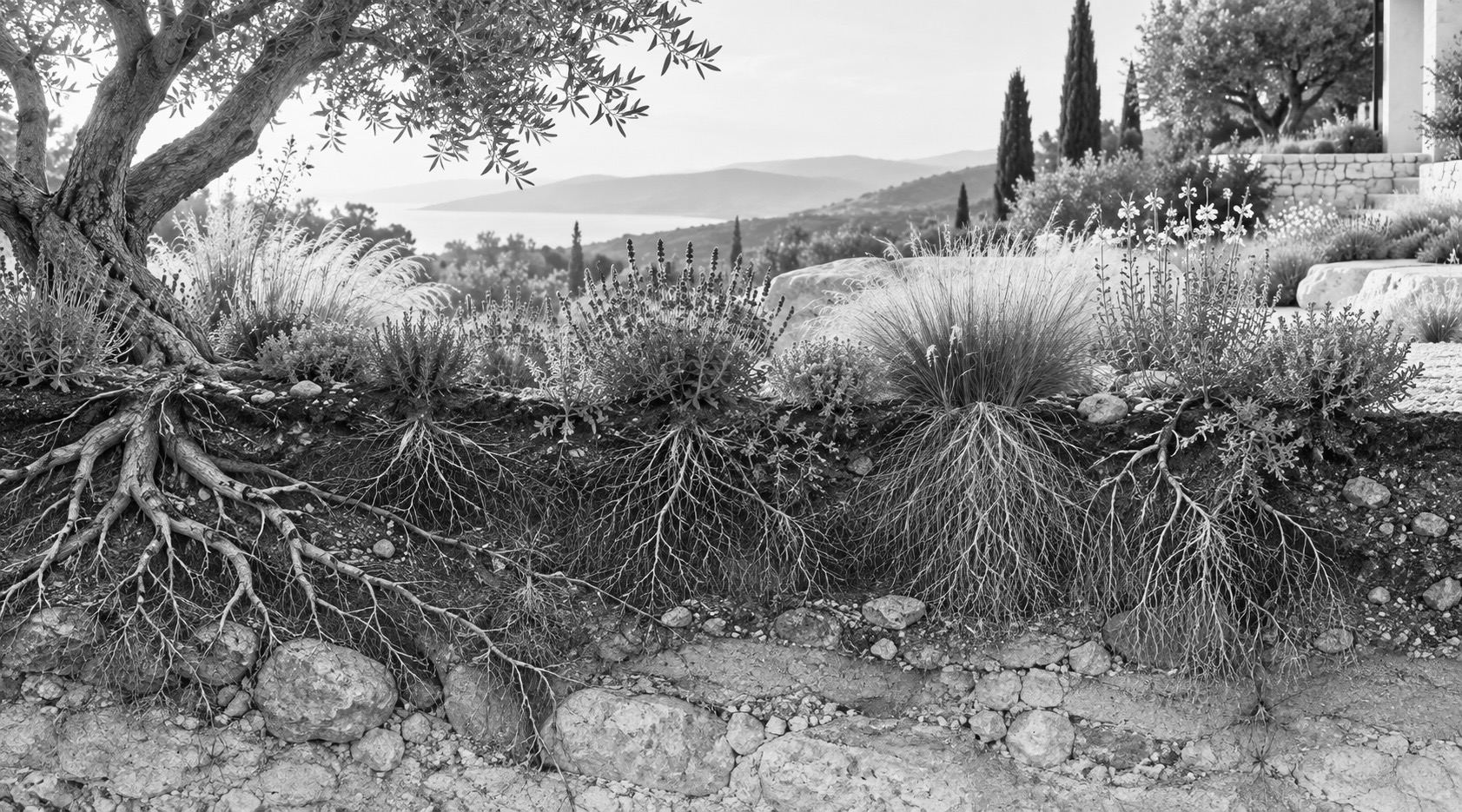
The soil: where a garden really begins
When a plant starts to struggle, we usually look upwards.
Yellow leaves, slow growth, dry tips, lack of flowering.
We check the irrigation, add fertiliser, move the plant somewhere else or wonder whether it is getting too much sun.
But very often, the problem is lower down.
In the soil.
A part of the garden we barely see and yet one that deeply affects the way a plant will grow.
In landscaping, we talk a great deal about species, shapes, colours, flowering, water requirements or sun exposure. The soil tends to enter the conversation much later.
Sometimes it is simply taken for granted.
The ground is prepared, topsoil is added, planting begins and the work moves on.
And that is not always enough.
Because soil is not simply what holds a plant in place.
It is the environment where its roots will develop, where it will find water, air and much of the nutrition it needs.
Understanding it before planting changes many decisions.
Two identical plants can behave in completely different ways
We can plant the same species in two gardens only a few kilometres apart, with almost the same climate and similar exposure, and get very different results.
One may have light, free-draining soil.
The other, heavy ground that stays wet for days after rainfall.
In one, the roots will move through the soil with ease.
In the other, they will meet resistance.
One will retain more moisture.
The other will lose water quickly.
These differences may go unnoticed from the surface, but for a plant they are part of its immediate environment.
Soil texture, depth, compaction, organic matter, drainage, pH and even the presence of salts all influence root development and the availability of water and nutrients.
That is why talking about a plant without talking about the soil it will grow in always leaves out an important part of the story.
There is no single good soil for every plant
We tend to talk about “good” soil as though there were one ideal composition suitable for every garden.
It does not quite work like that.
Some soils are more fertile, better structured or more suitable for a wide range of species.
But plants do not all have the same needs.
Lavender can thrive in relatively poor, stony and very free-draining ground.
That same place may be unsuitable for a plant that needs more constant moisture and a soil rich in organic matter.
Rosemary, santolina, teucrium and many species associated with Mediterranean landscapes are adapted to conditions that would be uncomfortable for other plants.
The opposite is also true.
Some species can adapt to a fairly broad range of soils, while others are much more sensitive to particular pH levels, poor drainage or salinity.
The aim, then, is not to find the perfect soil.
It is to understand the soil we have and to know which plants can genuinely thrive in it.
Water does not explain everything
One of the easiest mistakes to make when a plant begins to show signs of weakness is to assume that it needs more water.
Sometimes that will be the case.
At other times, exactly the opposite may be happening.
Roots need oxygen too.
When soil remains saturated for too long, water fills the spaces that would normally contain air, and the roots begin to function under unfavourable conditions.
Compacted ground can have a similar effect.
Water moves through it less effectively, aeration decreases and roots have more difficulty expanding.
A poorly drained soil may contain plenty of water and still keep a plant under stress.
That is why increasing irrigation without first understanding what is happening below ground can make the problem worse.
This is especially important when working with many Mediterranean species.
Plants that can withstand months of heat, poor soil and even long periods of drought may suffer very quickly when their roots remain constantly waterlogged.
Sometimes, taking better care of them means doing less.
pH is invisible too
There is another characteristic of soil that is easy to overlook: its pH.
We may have a soil that contains nutrients and a plant that, in theory, should grow perfectly well.
And yet, depending on the pH, some of those nutrients may be far less accessible to its roots.
This is one of the reasons why a plant can show signs of deficiency even when the element it needs is present in the ground.
In alkaline soils, for example, the availability of certain nutrients such as iron and manganese is reduced.
Some species tolerate these conditions perfectly well.
Others begin to show chlorosis, weak growth and increasingly pale leaves.
We can add iron, correct a deficiency temporarily and improve the appearance of the plant.
But if we still do not understand the cause, we will probably have to repeat that intervention again and again.
That is the difference between treating a symptom and understanding the place.
Design also means knowing what lies beneath
Before deciding what to plant, it is worth observing the ground with the same attention we give to the orientation of the house, the views or the way sunlight moves across the site.
See how it reacts after rain.
Check whether the water disappears quickly or remains for hours.
Look at its texture.
Find out whether there is a compacted layer.
Understand its real depth.
And when the project requires it, analyse the parameters that cannot be known simply by picking up a handful of soil.
A soil analysis does not design a garden.
But it can prevent many wrong decisions.
It can also help explain why certain plants that seemed appropriate on paper have never really worked in a particular place.
We can improve the soil, but it does not always make sense to fight against it
Of course, soil can be improved.
We can add organic matter, correct structural problems, improve drainage or prepare specific areas for particular planting.
That is part of the work.
But there is a difference between improving a soil and trying to turn it permanently into something it is not.
When we choose a plant whose needs are far removed from the natural conditions of the site, we begin to compensate.
More irrigation.
More fertilisation.
pH corrections.
Treatments.
Replacements.
Maintenance.
All to keep a plant in a place that was never really suited to it.
Sometimes it can be done.
The question is whether it makes sense.
In a Mediterranean garden especially, working with the existing conditions usually creates more stable spaces, with less dependency and a much more natural evolution.
Plant selection then stops being purely an aesthetic decision.
The soil becomes part of the design too.
Look at the place first
Before asking what we want to plant, there is a more interesting question.
What can live well here?
It does not mean giving up on design or limiting the possibilities.
It means starting from real information.
The soil can be improved.
The planting can be selected.
The irrigation can be adapted.
But the more coherent those decisions are with one another, the less effort we will need later to keep the garden working.
Perhaps that is why one of the most important parts of a project happens before the first plant goes into the ground.
Look at the site.
Understand how it works.
And design from there.
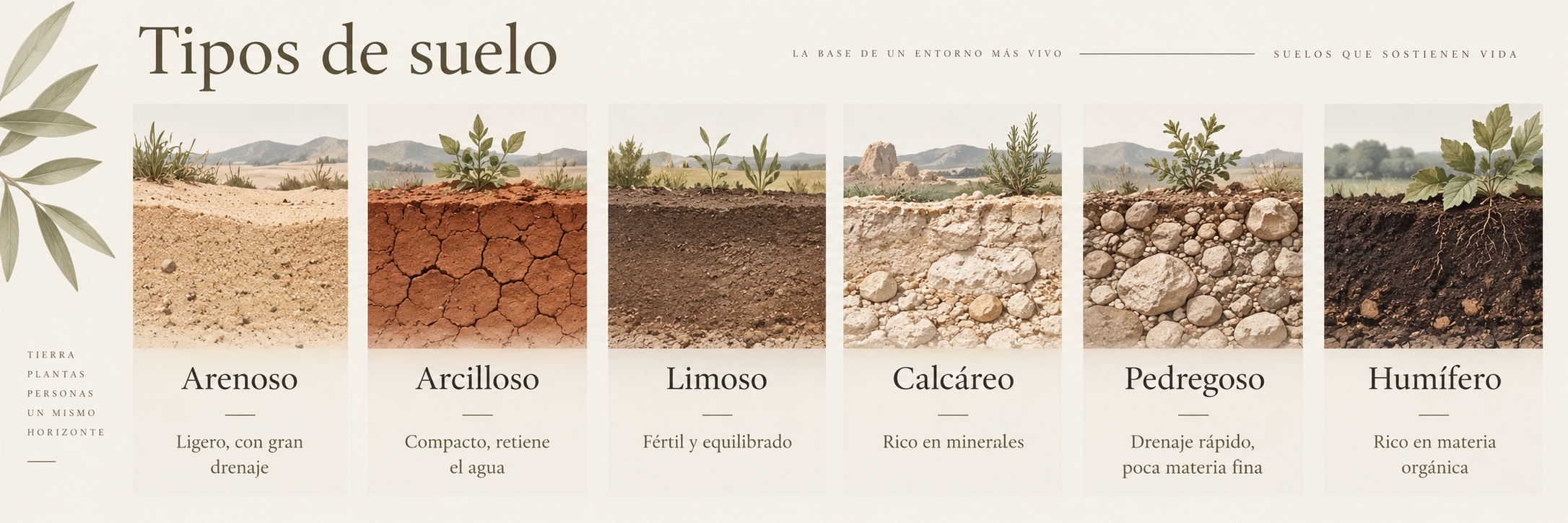
El suelo: donde realmente empieza un jardín
Cuando una planta empieza a fallar, solemos mirar hacia arriba.
Hojas amarillas, crecimiento lento, puntas secas, falta de floración.
Revisamos el riego, añadimos abono, cambiamos alguna planta de sitio o pensamos que quizá recibe demasiado sol.
Pero muchas veces el problema está más abajo.
En el suelo.
Una parte del jardín que apenas vemos y que, sin embargo, condiciona profundamente la manera en que una planta va a crecer.
En paisajismo hablamos mucho de especies, formas, colores, floraciones, necesidades de agua o exposición solar. El suelo suele entrar bastante más tarde en la conversación.
A veces se da por hecho.
Se prepara el terreno, se aporta tierra vegetal, se planta y se continúa.
Y no siempre es suficiente.
Porque el suelo no es simplemente aquello que utilizamos para sujetar una planta.
Es el medio en el que van a desarrollarse sus raíces, donde encontrará agua, aire y buena parte de los nutrientes que necesita.
Entenderlo antes de plantar cambia muchas decisiones.
Dos plantas iguales pueden comportarse de forma completamente distinta
Podemos plantar la misma especie en dos jardines situados a pocos kilómetros de distancia, con prácticamente el mismo clima y una exposición similar, y obtener resultados muy diferentes.
Uno puede tener un terreno ligero y drenante.
El otro, una tierra pesada que permanece húmeda durante días después de una lluvia.
En uno las raíces avanzarán con facilidad.
En el otro encontrarán resistencia.
Uno conservará más humedad.
El otro perderá el agua rápidamente.
Son diferencias que desde la superficie pueden pasar desapercibidas, pero para una planta forman parte de su entorno inmediato.
La textura del suelo, su profundidad, la compactación, la cantidad de materia orgánica, el drenaje, el pH o incluso la presencia de sales condicionan el desarrollo de las raíces y la disponibilidad de agua y nutrientes.
Por eso hablar de una planta sin hablar del suelo donde va a crecer siempre deja una parte importante de la historia fuera.
No existe un buen suelo para todas las plantas
Tenemos cierta tendencia a hablar de una tierra “buena” como si existiera una composición ideal que sirviera para cualquier jardín.
No funciona exactamente así.
Hay suelos más fértiles, más estructurados o con mejores condiciones para un amplio número de especies.
Pero las necesidades de las plantas no son iguales.
Una lavanda puede desarrollarse perfectamente en un terreno relativamente pobre, pedregoso y muy drenante.
Ese mismo lugar puede resultar poco adecuado para una planta que necesita humedad más constante y un suelo rico en materia orgánica.
Romeros, santolinas, teucrium o muchas especies propias del paisaje mediterráneo están acostumbrados a condiciones que serían incómodas para otras plantas.
También ocurre al contrario.
Hay especies capaces de adaptarse a un rango bastante amplio de terrenos y otras mucho más sensibles a determinados valores de pH, a la falta de drenaje o a la presencia de sales.
No se trata, por tanto, de encontrar el suelo perfecto.
Se trata de conocer el suelo que tenemos y entender qué plantas pueden desarrollarse bien en él.
El agua no lo explica todo
Uno de los errores más fáciles de cometer cuando una planta muestra síntomas de debilidad es pensar inmediatamente en falta de agua.
Y algunas veces será así.
Otras veces puede estar ocurriendo exactamente lo contrario.
Las raíces también necesitan oxígeno.
Cuando un suelo permanece saturado durante demasiado tiempo, el agua ocupa los espacios que normalmente contienen aire y las raíces empiezan a trabajar en condiciones desfavorables.
Un terreno compacto puede producir un efecto parecido.
El agua circula peor, la aireación disminuye y las raíces encuentran más dificultad para avanzar.
Un suelo mal drenado puede tener agua de sobra y, aun así, mantener una planta bajo estrés.
Por eso aumentar el riego sin entender antes lo que está ocurriendo debajo puede empeorar el problema.
Esto es especialmente importante cuando trabajamos con muchas especies mediterráneas.
Plantas que soportan meses de calor, terrenos pobres e incluso largos periodos de sequía pueden sufrir rápidamente cuando sus raíces permanecen continuamente encharcadas.
A veces cuidarlas mejor consiste, precisamente, en intervenir menos.
El pH tampoco se ve
Hay otra característica del suelo que pasa fácilmente inadvertida: su pH.
Podemos tener un terreno con nutrientes y una planta que, aparentemente, debería crecer sin problemas.
Sin embargo, dependiendo del pH, algunos de esos nutrientes pueden resultar mucho menos accesibles para sus raíces.
Es uno de los motivos por los que una planta puede presentar síntomas de carencia aunque el elemento que necesita esté presente en el terreno.
En suelos alcalinos, por ejemplo, disminuye la disponibilidad de determinados nutrientes como el hierro y el manganeso.
Algunas especies toleran perfectamente estas condiciones.
Otras empiezan a mostrar clorosis, crecimiento débil y hojas cada vez más pálidas.
Podemos añadir hierro, corregir temporalmente una carencia y mejorar el aspecto de la planta.
Pero si seguimos sin comprender la causa, probablemente tendremos que repetir esa intervención una y otra vez.
Ahí está la diferencia entre tratar un síntoma y entender el lugar.
Diseñar también consiste en saber qué hay debajo
Antes de decidir una plantación conviene observar el terreno con la misma atención con la que observamos la orientación de la casa, las vistas o la incidencia del sol.
Ver cómo responde después de una lluvia.
Comprobar si el agua desaparece rápidamente o permanece durante horas.
Observar su textura.
Saber si existe una capa compactada.
Conocer su profundidad real.
Y cuando el proyecto lo requiere, analizar también parámetros que no podemos conocer simplemente cogiendo un puñado de tierra con la mano.
Un análisis de suelo no diseña un jardín.
Pero puede evitar bastantes decisiones equivocadas.
También ayuda a entender por qué determinadas plantas que sobre el papel parecían adecuadas nunca han terminado de funcionar en un lugar.
Podemos modificar el suelo, pero no siempre tiene sentido luchar contra él
Naturalmente, un suelo puede mejorarse.
Podemos incorporar materia orgánica, corregir problemas de estructura, trabajar el drenaje o preparar zonas específicas para determinadas plantaciones.
Eso forma parte del trabajo.
Pero existe una diferencia entre mejorar un terreno y pretender convertirlo de manera permanente en algo que no es.
Cuando escogemos una planta cuyas necesidades están muy alejadas de las condiciones naturales del lugar, empezamos a compensar.
Más riego.
Más fertilización.
Correcciones del pH.
Tratamientos.
Reposiciones.
Mantenimiento.
Todo para conseguir que una planta permanezca en un lugar que nunca terminó de ser adecuado para ella.
A veces se puede hacer.
La cuestión es si tiene sentido hacerlo.
En un jardín mediterráneo, especialmente, trabajar con las condiciones existentes suele producir espacios más estables, con menos dependencia y una evolución mucho más natural.
La selección vegetal deja entonces de responder únicamente a una cuestión estética.
El suelo también participa en el diseño.
Mirar primero el lugar
Antes de pensar qué queremos plantar, hay una pregunta más interesante.
¿Qué puede vivir bien aquí?
No significa renunciar al diseño ni limitar las posibilidades.
Significa partir de información real.
El suelo puede mejorarse.
La vegetación puede elegirse.
El riego puede adaptarse.
Pero cuanto más coherentes sean esas decisiones entre sí, menos esfuerzo necesitaremos después para sostener el jardín.
Quizá por eso una de las partes más importantes de un proyecto sucede antes de colocar la primera planta.
Mirar el terreno.
Entender cómo funciona.
Y diseñar a partir de ahí.